.svg)
In summer 2024 I was contacted by the owner of Villa da Lisca, a property dating back to the 15th century in Zevio, just outside Verona. She wanted to commission three collections of ceramics specifically for display in this property, currently undergoing a sequence of renovations. She was particularly interested in my work as it strongly references Italian Renaissance maiolica, and had seen my ‘Menopause in Maiolica’ series at ‘Collect’ at Somerset House, London, in 2024. The maternal line of the da Liscas will end with the client’s mother and she wants to honour the family with this commission.
We met several times over the ensuing year – on a visit to the Villa da Lisca, during my solo exhibition at the Scottish Gallery in Edinburgh, and in spring 2025 during a research trip to Florence. The client told me about the origins of the da Lisca family, which provided the seed of the idea I had for my way forward in how to approach this commission.
The da Liscas are a noble family with origins in Florence. In the 13th century, they were ejected from Tuscany as a result of a war, subsequently moving to Verona. At this point the family achieved success through their services as mercenaries (‘Condottieri’) for the local nobility; and became in time a noble family themselves - with a coat of arms, land and new buildings erected in their name.
RESEARCH
During my trip to Florence in spring 2025 I visited the Bargello museum to look at the superlative collection of Renaissance Maiolica, as well as the huge array of Della Robbia roundels on display there. I was particularly struck by a large group of ornate tableware that had been commissioned by the Medici family in the Maiolica room; plus some fine examples of dragon spouted pharmacy jars, known as Orsini-Colonna, displayed nearby. (There are also several large-scale roundels featuring typical ornate fruit, flower and foliage frames by the Della Robbia family on the walls above the display cases in this room, and as I’d recently made a version of one of these I was fascinated to see them at close range.)
After another day or two of sightseeing in Florence, and a meeting with my patron which took place very close to the Pitti Palace (the Florentine residence of the Medicis), the commission fell into place. It struck me that my patron is a contemporary exponent of the long tradition of art patronage in Italy, in the vein of the Medici family. Making this connection helped to make sense of the brief I’d been given, and I remembered the collection of tableware made for the Medicis at the Maiolica room in the Bargello.
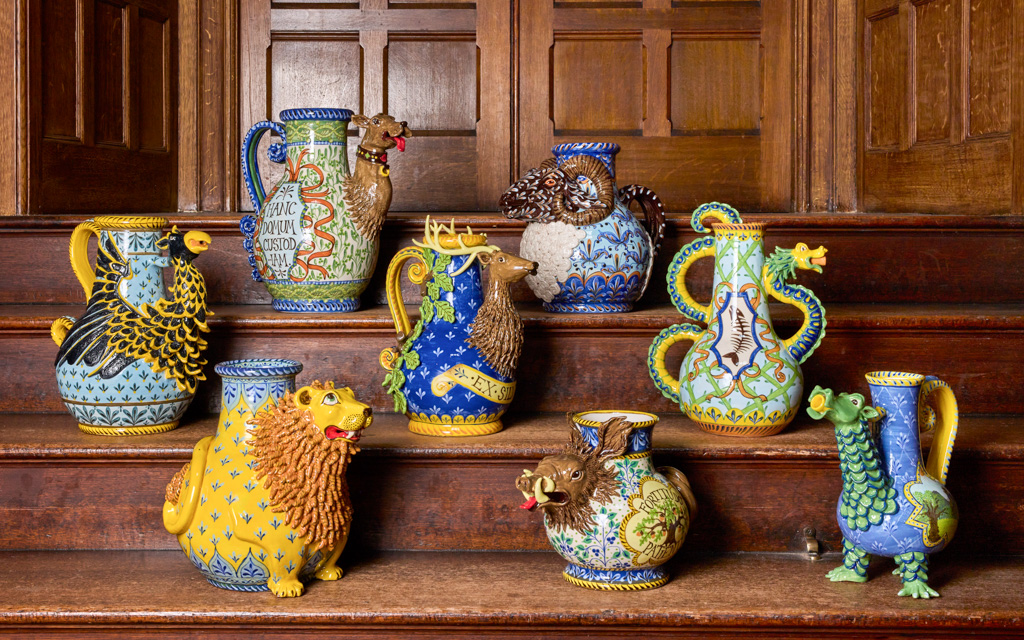
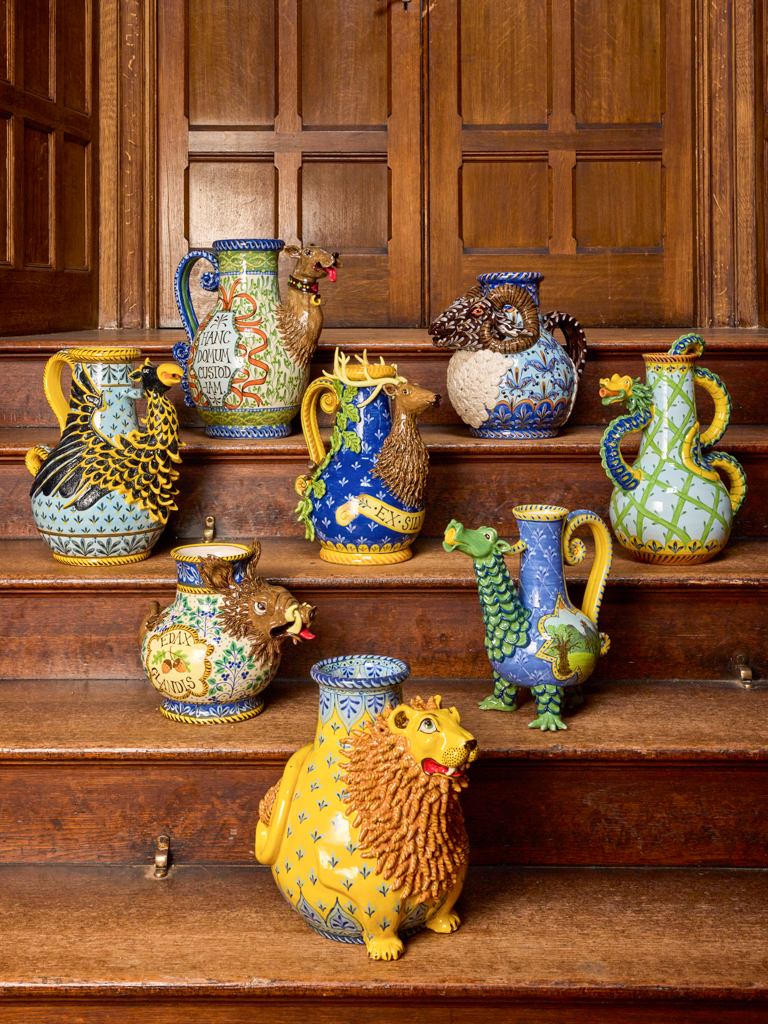
I decided that I’d make a collection of vessels, using the Medici tableware as a starting point. I wanted to create a kind of ‘battalion’ of heraldic beast jugs and vases for this first commission, to reference the background of mercenary/political activity of the da Lisca family and their coat of arms, and to use the dragon spouted Orsini-Colonna jars as a model for how to construct the vessels. The resulting collection of eight ‘Heraldic Beasts’ can be displayed together, in small groups or separately, and as such are a versatile collection that can be arranged and situated as required.
I have included the motif of the oak tree in many of these pieces, as this venerable tree is part of the da Lisca coat of arms; and one of the vessels is a gryphon - the other half of this coat of arms. I have also played with the fishbone motif, which translates to ‘lisca’ in Italian.
INSPIRATION FROM THE ORSINI-COLONNA JARS
The first jug I made was most directly modelled on the Orsini-Colonna type, featuring a dragon spout and an imaginary Tuscan landscape on one side of the body, to reference the geographic origins of the family. I was most confident about making this piece, having already made a large-scale dragon spouted jar for a previous collection; the one the client had seen at ‘Collect’ in 2024. I first encountered a dragon spouted jar at the Courtauld in 2023 and straightaway wanted to try making one of my own.
Historical note from Elisa P Sani: Jars with moulded spouts shaped like the head and neck of a dragon are the most distinctive type of pharmacy vessels made during the Italian Renaissance. Their shape is inspired by contemporary metalwork ewers. They were made for liquid medicines, such as syrups, oils or perfumed waters as they always have painted labels with the name of the contents in handsome gothic lettering. For a long time their fantastic form and origin puzzled scholars and collectors alike. One of these jars now at the British Museum has the emblem of a bear hugging a column with the motto ET SARRIMO BONI AMICI (and we shall be good friends) with evident reference to two of the most powerful families in Rome, the Orsini and the Colonna, which were often at war with each other. It was only following the discovery of fragments in the town of Castelli - in the mountains in the Abruzzi region - by local archeologists in the 1980s that the origin of the Orsini-Colonna jars became clear. They were made at Castelli in the workshop of Orazio Pompei (ca 1507-1588).
The Orsini-Colonna jars are often painted with animals: bears, dogs and even a cat. In Katrin’s versions of them all eight animals, not just the dragon, take their turn holding fort on the spouts. In the Renaissance all animals bear symbolic meanings. Katrin’s beasts symbolize strength, loyalty, protection, alliance and wisdom. Her jars move from the pharmacy shelf to the banqueting hall, to celebrate the Da Lisca family.
TECHNICAL CHALLENGES
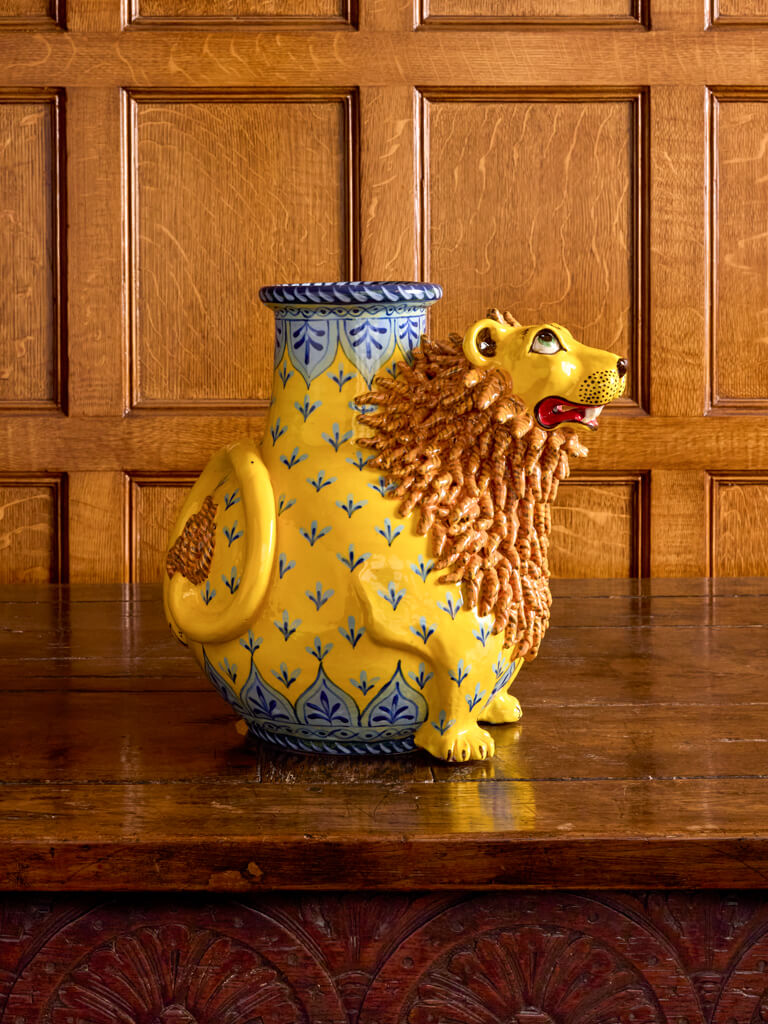
The most difficult technical challenge for this set of vessels was in how to construct the animal heads and necks in such a way that they would securely attach to the main part of the vessel; and have a happy relationship with the shape of the main body of the vessel. In some cases (such as with the Lion), I abandoned the idea of making a working spout and focused instead on getting the right profile to represent the animal. All three vessels (the Boar, Ram and Lion) that feature heads only or very short necks, are not the right shape to make a pouring spout, so they work only as vases. I did toy with the idea of making a long narrow tube to fit inside the centre of these heads and attach from the inside of the mouth to the vessel body so that I would have a pouring element, but this would have added many complications: the head section would have been very heavy and so would be more likely to crack or break away from the vessel body during construction and firing, and there would have been an issue with creating air pockets between the tube and the inside of the animal head – something which causes disastrous blow-outs in the firing process.
HEAD AND NECK CONSTRUCTION
I also experienced quite a ‘journey’ in working out how to make the curved and tapering animal necks. The dragon spouted vessel has a straight neck, as it is made from a wheel-thrown straight cylinder. (I have much more experience in throwing than in making sculptural elements). This is obviously not the correct shape for any animal’s neck, and so I thought about how to make a hollow, curved, tapering shape that could be a basic template to alter and refine for the different animal necks. I tried to make a couple from thrown ‘doughnut’ shapes: I threw hollow rings on the wheel and cut them in order to reattach at different angles, to try and achieve the ‘swan neck’ shape – but this proved unsuccessful as the tapering element was missing. I did make the ‘Biscione’ or grass snake vessel spout in this way, and carried the idea through to the multi-part handle that represents the body and tail of the beast, which worked out well but only for this one tube-like animal.
So then I made a ‘former’ by hand: I drew a template of the basic tapering, curved shape I wanted on a piece of paper and used that to guide me in the beginning stages of carving out the shape from a solid block of clay, which was soft enough to alter and refine with my hands. The resulting shape was thoroughly dried out/hardened, and I covered this in layers of cling film, so that I’d be able to wrap sheets of soft clay around it without the soft clay sticking to the former, to make a hollow, curved neck. I had to cut vertically through this in order to remove the former from inside, and then reattached the two pieces together. This was the basis for the Gryphon’s neck. But I realized that I was again limited with how the resulting neck would be shaped, and so I went back to the wheel and made all six subsequent heads and necks individually from thrown hollow cones of varying profiles and dimensions, which were cut and reattached at angles to give me a starting point for refining, modelling the features and adding other details such as ears, shaggy coats, manes, antlers etc.
PROBLEMS!
I had a difficult time with the Stag vessel. After the first ‘bisque’ firing, I found that a long crack had opened up, from the bottom of the stag’s neck all the way down to the base of the vessel. At first I thought this must have occurred as a result of throwing the separate foot ring onto the base, but after a long and much appreciated conversation with Jo Taylor, a ceramicist specializing in making large-scale vessels with sculptural elements attached, the conclusion I came to was that I’d thrown the walls of the lower half of the vessel too thinly, with the result that it simply was not structurally sound enough to cope with the extra weight demands of the attached head and neck. That piece taught me that when scaling up in size, and attaching large extra elements, I need to start off with a really sturdy, thickly thrown vessel.
VESSEL CONSTRUCTION
The vessels are all thrown in three or more parts – two ‘bowl’ shapes that are attached at the rims to form the body of the vessel, and one cylinder to attach to the resulting piece for the neck part. I’ve often made the top of the neck with a rolled, hollow rim feature, as this can often be seen in Italian Renaissance maiolica vessels, and it really finishes off the profile of large pieces nicely. Other elements are then attached, such as thrown foot rings, animal legs and feet, the head/neck features and handles. Some of the very thickly thrown bases made after my experience with the Stag have foot rings carved out of them in one piece, so that I don’t have to attach a separate element which is always a stress point in construction and firing.
CLAY BODY AND TECHNICAL NOTES
I changed the clay body I used for this collection, to one with a much higher grog or sand content than I normally use. I was a bit concerned that this rougher body would make modelling the fine details difficult, but that proved not to be the case. The clay is a 15% sanded red earthenware, which I paint over with thick white slip to act as a canvas for the underglaze decorations – and to emulate the tin glazing of antique maiolica. All of the decoration is done at the ‘green’ stage, before being bisque fired to 1080c, and then a clear lead-free glaze is applied and then glaze fired also to 1080c.
Katrin Moye
with contribution by Elisa P Sani
January 2026