
.svg)
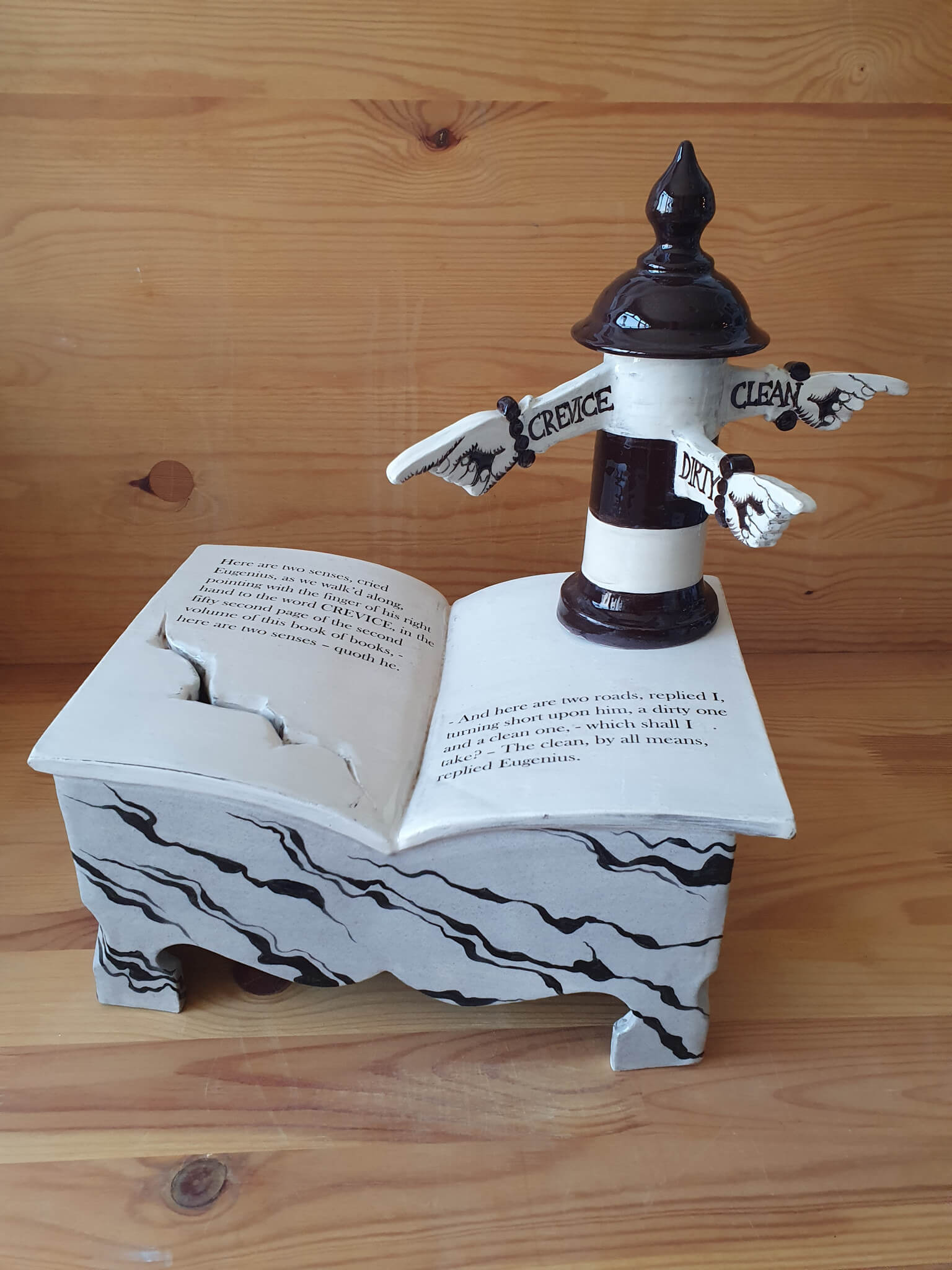
In 2020 ceramicist Katrin Moye was due to hold an exhibition of works responding to the novel, The Life and Opinions of Tristram Shandy, Gentleman (1759–67) at the Laurence Sterne Trust’s Shandy Hall. The coronavirus pandemic delayed and shaped her work. Filthy Trash, as the exhibition came to be called, finally took place in July and August 2021, featuring nine sculptures inspired by the Delftware and Staffordshire figures of the period. The nine three-dimensional pieces, corresponding to the nine volumes of Sterne’s novel, explore the bawdy side of Tristram Shandy, focussing on the crevice in the wall, the hot chestnut, Dolly’s sealing wax, a nose/book/mountainous promontory, a cabbage plot with a slit petticoat, a squirt, Toby’s pipe on the fender, a keyhole, and a buttonhole.1
Moye also produced some works from a cast of the Nollekens bust of Sterne held at Shandy Hall. Fifty noses, some painted in flesh colours and others gilded, were presented in a gift box together with a ‘man-size’ cotton handkerchief, the box printed with the quotation, ‘blow your noses — cleanse your emunctories — sneeze, my good people! — God bless you’ (TS 9.20.773). A collection of nine chamber pots were produced, some with noses poking up from the bottoms of the bowls, and some featuring nose handles. The Sterne-inspired collection was displayed alongside a series of albarello jars responding to public messaging during the pandemic.
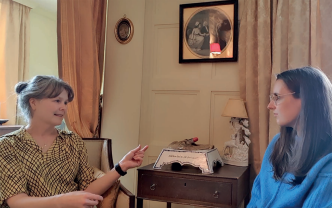
In the below interview, from Summer 2021 (Figure 45), Moye explores with Helen Williams the aspects of the novel that most intrigued her, giving an insight into her research practice and the role of the female artist in tackling eighteenth-century bawdry.
Helen: Do you want to talk a little bit about what kind of impact the pandemic had on the kind of work that you produce?
Katrin: Yes, because that became a really big factor for me in this project because I was talking to the curator here, Patrick Wildgust,
The Shandean 34, 2023–2024 ISSN 3049-4788 https://doi.org/10.3828/shandean.2024.15
Downloaded from www.liverpooluniversitypress.co.uk by Helen Williams on February 12, 2025. For personal use only. No other uses without permission from the rightsholder.
204 the shandean
in 2018, 2019, planning and making work for an exhibition. I hadn’t decided what exactly I was going to make, but I knew I wanted to make something based on Staffordshire figures, which were a popular eighteenth-century domestic decorative item. Then the pandemic hit. And actually, that was quite fortuitous for me because that gave me a lot of time and mental space to think about the project 100% and really focus on it. So actually, that really helped me, but conversely the pandemic did put many roadblocks in my way. Everything that I wanted to do, everything that I was planning to do, suddenly I couldn’t, and I had to keep negotiating my way around these barriers that the pandemic put up, very much like the narrative of Tristram Shandy.
Helen: Of Tristram having all of these, you know, misadventures and cross accidents befall him, not only in his life, but in his attempt to create art, you know, and to capture that life in book form.
Katrin: So, things, external events, happen to Tristram and other characters in the book.
Helen: Life, that chapter of accidents.
Katrin: Yes, yes. And I did feel kind of … It did, it did make me laugh, actually, though. I felt like I was somehow sucked into the book and I’d become a peripheral character, by having all these issues and problems. And then, oh, there was a rumour going around about how the supplier of clay had run out of clay. And that was it. What am I going to do now?
Helen: Stockpile it with the toilet roll.
Katrin: Yes, exactly.
Helen: We talked about recycling clay at one point. Did you do that?
Katrin: We did, didn’t we? We had lots of conversations about how I was going to approach the novel. And you told me some really interesting things about the physical descriptions of actual paper, which really intrigued me.
Helen: About it being torn up or burned ...
Downloaded from www.liverpooluniversitypress.co.uk by Helen Williams on February 12, 2025. For personal use only. No other uses without permission from the rightsholder.
katrin moye’s f i lt h y t r a s h 205
Katrin: Do you remember the butter paper?
Helen: Yeah, in A Sentimental Journey, where Yorick is enjoying his breakfast then realises that it’s a fragment of a manuscript, and then the narrative turns into the sort of adventures of this manuscript. He tries to trace it back to its source to find out what happens in the end. And, you know, there are a series of accidents. Yeah. But yeah, paper being recycled is a sort of motif that happens in Tristram Shandy as well, isn’t it, with Tristram’s fragments being repurposed as curling papers and having to rescue them from that woman’s head. Yeah. And that anxiety that the fact that his fragments might be so close to her brain she might absorb these ideas.
Katrin: Oh, really? Oh, well, that reminds me of the sealing wax. The anecdote about Dolly and her sealing wax, which is presented on this sculpture here. So, you sent me an essay to read about the impres sionable female mind being represented by sealing wax.
Helen: Yes, by Amelia Dale.
Katrin: Yeah. Could you just refresh my memory about the Dolly episode?
Downloaded from www.liverpooluniversitypress.co.uk by Helen Williams on February 12, 2025. For personal use only. No other uses without permission from the rightsholder.
206 the shandean
Helen: So, it’s like an allusion to John Locke as well, isn’t it, about how ideas are generated in the mind, but what Tristram — and Sterne — does with it quite cleverly is to create this metaphor of seal and wax being mouldable in the hand. And what’s quite significant about that moment in the novel is that it’s this female character, Dolly, with her hand in the pocket and the sealing wax in her pocket and … You know, we talked about eighteenth-century clothing, didn’t we, and how pockets were actually quite an intimate part of somebody’s attire. They would have been beneath the clothes, you know, and it’s like, very, very close to the body in a place of intimacy that you wouldn’t really expect anybody to access, to be able to see.
Katrin: Not, like, a pocket like this [Katrin gestures to modern clothing]. It was a separate garment, wasn’t it, that you could sort of wear as an undergarment. And actually, the shape of the pocket, seen from above, is quite suggestive.
Helen: Yeah! And I guess that the contemporary anxieties that Sterne is playing on in that scene are to do with how we generate ideas, how we pass on information, but also about the sort of the gendered anxieties around that, about how women’s ideas might be particularly sexualised, if you like, or might be prone to reading perhaps too much between the lines.
Katrin: Because they’re so impressionable.
Helen: Yes, but there’s also, I think, a really nice metaphor with that concept of impression and of imprinting, which is also quite characteris tically Sternean, in sort of alluding to the printing process as well and, you know, the method by which the words and texts and the narrative are imprinted and impressed upon the page. In a way which would have been so much more visible and with which eighteenth-century readers would have been much more familiar, you know, like reading a printed text and seeing the way in which those letters are, you know, really three dimensional or raised.
Katrin: Yes. Yeah.
Helen: So, like our brains.
Katrin: Yes, that was what I was thinking. First of all, I was going
Downloaded from www.liverpooluniversitypress.co.uk by Helen Williams on February 12, 2025. For personal use only. No other uses without permission from the rightsholder.
katrin moye’s f i lt h y t r a s h 207
to concentrate on recreating these paper items, like the screwed-up chapter. That didn’t make it in …
Helen: … because it was too good (like my best research, everyone!).
Katrin: Exactly. Yeah. So, then I thought, I don’t know, I just went through loads and loads of different ideas and themes, and then this one of the sealing wax just delighted me in a way that I thought, you know what? I’m just going to concentrate on the dirty jokes and the innuendo.
Helen: You do such a good job of making them three dimensional, actually. You know, like they become very visual.
Katrin: Yes. And it is quite a visual book, isn’t it?
Helen: I think so.
Katrin: Because there’s a … isn’t there a connection with Sterne and the theatre world? Did I hear?
Helen: Yeah, that’s right. With Garrick. And also with Hogarth. I think Stone was really sort of savvy about making sure that he was connected with the celebrities of his age. And so, I think it’s important to remember that Tristram Shandy was a book which, you know, when the first volumes came out and when he realised how successful they were, he went straight to the first artist of the age, William Hogarth. ‘Can you do the frontispiece?’ ‘Can you do an illustration?’ And that book is really unusual for that period in being designed as a book with illustrations from its first edition. So, the subsequent volumes came out with illustrations; that really characterises Tristram Shandy as quite a luxury book, actually, in that period. And he does something similar with the Sermons as well that becomes like a collaboration with Joshua Reynolds, the foremost portrait artist of the day. He gets his portrait done by Reynolds, which becomes the frontispiece to the Sermons, and there’s something about that collaboration with the art world, which I suppose makes Tristram Shandy really unique, but is also reflected in Sterne’s own sort of preoccupation with how his book appears as a visual artefact. You know, it’s a very much a novel which has visual effects which are intended to lead us.
Downloaded from www.liverpooluniversitypress.co.uk by Helen Williams on February 12, 2025. For personal use only. No other uses without permission from the rightsholder.
208 the shandean
Katrin: It’s a book. It’s a book as an object as much as a story to be read, isn’t it? He made sure that every book had a different piece of marbled paper. Is that right? And every single one was not a copy but was unique to itself. I really love that. I really like that kind of crunchiness of that book, for me.
Helen: It’s a book that sort of throws you out of the narrative all the time to remind you that you’re reading a book, a piece of technology, that works in ways that actually you might have been accustomed to ignore, like pagination, for instance. So, Sterne skips a few pages. I think it is still the only book in the world where the odd numbers appear on the right-hand side and the even numbers appear on the left. The pagination swaps in a way which is yet to be replicated.
Katrin: So, there’s all kinds of visual tricks, and it reminded me of stage in some parts of the narrative where he’s describing exactly how, for example, his father’s lying prostate on the bed. And it’s almost like it’s a stage direction that you’re reading. So, it was kind of quite … it’s a very visual book.
Helen: Dr Slop’s fall is another one of those scenes, like a vignette, where it is described in such meticulous detail that you can see it. One of the moments that is quite memorable, I think, is when Walter Shandy’s trying to get something out of this pocket. It’s the opposite pocket and it’s so low down. It’s really, really awkward. And you can just feel almost every muscle, as well as seeing the contortions of his body, and I think that style of detail, and building up layers of visual effect, is part and parcel of what makes the humour work so well.
Katrin: So, the humour is the thing that really caught my attention and made the book such a joy to read because it’s kind of, you know, it’s written in the eighteenth-century vernacular, so it is quite hard to get going with it.
Helen: The sentences are very long.
Katrin: So, if you’re not used to reading that kind of book, it’s a bit kind of, oh, it’s 900 pages of this or however many. So, the humour really kind of swept me along. And then we had a conversation about the place of humour and gender in the eighteenth century and how at one point Walter says, ‘I wouldn’t allow Mrs Shandy to read a novel’.
Downloaded from www.liverpooluniversitypress.co.uk by Helen Williams on February 12, 2025. For personal use only. No other uses without permission from the rightsholder.
katrin moye’s f i lt h y t r a s h 209
It would … I would only allow her to read a sermon and that ties in with how humour was the preserve of men and not women. And I read something really interesting about how a guffaw or a belly laugh seems really, really unladylike and you mustn’t do it because a shout of laughter is seen as a very similar thing to an orgasm. So, because they’re involuntary bodily responses, so you must keep your body under control, Madam, and so to laugh was not allowed.
Helen: So, there is a sort of hierarchy, if you like, of how you’re allowed to respond to humour in the eighteenth century, and men are held to this as well, and there’s a kind of response which is polite, and there’s a kind of response which is uncouth, and you’re right that the sort of belly laugh is something which would be frowned upon in polite society, but which men could, you know, undoubtedly get away with, yeah, much more than women. But you know, Sterne himself plays with the idea of the female reader throughout the novel, in a way which undermines Walter’s expectation that women shouldn’t read fiction, right, in the sense that Tristram might be of a different generation but he absolutely imagines that the person who is reading this book is potentially ‘Madam’ and that she might read it in ways that he implies that we should not be encouraged to follow. And Sterne even wrote about this in his letters too. You know, when he moved on from Tristram Shandy to writing A Sentimental Journey, he described Tristram Shandy as a work that women might read in the bedroom, but A Sentimental Journey they might read in the parlour. And he’s sort of setting up a distinction of respectability without ever suggesting that women shouldn’t read Tristram Shandy or don’t read Tristram Shandy, but, actually, it’s more an issue about what you read in public or, yeah, reputational reading, perhaps.
Katrin: So, don’t take Tristram Shandy on the Tube.
Helen: Yeah, or put a different a cover on it.
Katrin: So, I felt that and then you said something about how the whole entire nine volumes could be seen as an exploration of male sexual anxiety, performance anxiety, and once you told me that I really twigged.
Helen: Yeah, I think, like, impotence, in the broadest sense, is absolutely one of the main themes of that novel.
Downloaded from www.liverpooluniversitypress.co.uk by Helen Williams on February 12, 2025. For personal use only. No other uses without permission from the rightsholder.
210 the shandean
Katrin: Yeah. So, it’s a very male sort of gaze, really, very male centred. Helen: And also, one which is anxious about inadequacy?
Katrin: And yeah, the female characters are almost behind the scenes, apart from the widow.
Helen: But even then, all of the characters are filtered through Tristam’s perspective, right? Because he is a first-person narrator so everything and everybody we meet is sort of clouded by his perspective and there is no sense in which we are encouraged to take what Tristram says at face value and certainly not really encouraged to treat things the way that he does, I guess, so his ideas about the people that he describes are perhaps not Sterne’s ideas or our ideas.
Katrin: And that was the same thing with the double entendres that I noticed: don’t take anything at face value. That works in that way as well. Yeah. So … so that’s what I decided to do.
Helen: And the thing with Tristram is, you know, his narrative might run away from him, and he might not have control over his writing in the sense that he might let slip double entendres without realising. But Sterne absolutely knows.
Katrin: So, what we were going to talk about was the humour and the dirty jokes being a really central part of the novel and how possibly I, as a woman artist, was trespassing ground that was forbidden access to me.
Helen: Did you feel as if Tristram was warning you off?
Katrin: I did. I did feel a bit naughty, and I’ve never made such rude things before, and it’s kind of, it is in that tradition of, totally not like really kind of salacious, none of them are sexy — I don’t think —
Helen: But they require you to do a double take, don’t they, in the same way that I think a lot of Sterne’s text requires you to do a double reading: ‘is that what I’ve just read?’ So, I think it’s really interesting that, you know, that the quotation that you’ve got on the piece here is in Dolly’s words — actually this one, isn’t it? [Helen gestures to the sculpture shown in Figure 45.] You know, it’s obviously filtered
Downloaded from www.liverpooluniversitypress.co.uk by Helen Williams on February 12, 2025. For personal use only. No other uses without permission from the rightsholder.
katrin moye’s f i lt h y t r a s h 211

46 Katrin Moye, ‘’Tis an inch, Sir, of red seal-wax’ (2020). Image courtesy of the artist through Tristram’s narration, but still, you know that the joke, if you like, is one articulated by one of the female characters. You don’t get many of those.
Downloaded from www.liverpooluniversitypress.co.uk by Helen Williams on February 12, 2025. For personal use only. No other uses without permission from the rightsholder.
212 the shandean
Katrin: No, you don’t. So, I’m really glad that Dolly got her chance to shine.
Helen: And her pocket out.
Katrin: And her pocket out, yes.
Helen: We were reflecting on your approaching this novel as a female artist in that tradition of sort of extending the narrative of Sterne’s text and shaping its legacy through material culture. This is a tradition in which, you know, female artists have participated since the 1770s, with the likes of Angela Kauffman and her 1770s — iconic, now — portrait of the Maria character, which became sort of printed and reprinted, reproduced on ceramics, for the next few decades and the same with Lady Elizabeth Templetown, who produces the silhouette designs of Maria and of the Bourbonnois Shepherd, which become part of the

47 Katrin Moye, ‘Stay Home, Save Lives, Protect the NHS’, Albarellos (2020). Earthenware clay, white slip, underglazes, lead-free glaze. Courtesy of Katrin Moye
Downloaded from www.liverpooluniversitypress.co.uk by Helen Williams on February 12, 2025. For personal use only. No other uses without permission from the rightsholder.
katrin moye’s f i lt h y t r a s h 213
Jasperware collection for Wedgwood. Those were middle class items in people’s homes and those female artists sort of popularised those characters in what became a design movement. I mean, do you see yourself in that tradition?
Katrin: It is very much on the design end of the art spectrum that we get female contributors to the manufacture of pottery in Stoke-on-Trent, right from Lady Templetown through to Clarice Cliff in the ’20s and ’30s and then Jesse Tate for Midwinter a bit later on. And so, I’m quite intrigued by how women artists are kept in that domestic framework of ‘you can display these things because they’re used in the home’ rather than being elevated in a gallery setting and not seen as art for art galleries but as for your home, for your domestic scenery, so I do feel as a maker of functional ceramics I’m very much inside that tradition. So actually, this project has given me a chance to break out of that because these are not functional in any way. They are being displayed in an art gallery and that does feel different for me. Yeah.
Helen: But also, situating them within the literary house museum as well has also been an important part of that.
Katrin: I feel like, in a way, I was validated by making work based on a ‘proper’ work of art, which is Tristram Shandy, so these are not things that I’ve made up out of nowhere, I’ve responded to a text that was already in existence, so …
Helen: Is that about text or is that about the research process?
Katrin: I think it’s about … I’ve done this before. I’ve responded to literature in different ways before and I think it’s possibly partly because I’m, in a very female way, unsure about the validity of my own voice, so if I’ve got something to say, who’s going to want to hear that? [Helen raises her hand] Well, yes, I am getting over that slowly. But that’s where it all started for me. Who’s going to want to see a piece of art that I’ve made? But people are going to want to see a piece of art that I’ve made based on another piece of art that’s already firmly established in the world.
Helen: And your exhibition features artwork that responds to the COVID-19 pandemic as well (Figure 46). So, they’re not strictly tied to Tristram Shandy.
Downloaded from www.liverpooluniversitypress.co.uk by Helen Williams on February 12, 2025. For personal use only. No other uses without permission from the rightsholder.
214 the shandean
Katrin: I made those during and after this project, sort of in the thick of the pandemic. And I did feel like I’d pretty much gotten over myself and found my voice as an artist.
Helen: There’s a politics to those pieces in the same way that I think there’s a politics to these.
Katrin: Yes, there is and they are found texts in the same way. So, I’m quoting Boris Johnson, Dominic Cummings, and, you know, the whole … those three-phrase slogans that we heard over and over again when Dominic Cummings was still the main advisor — hands, face, space and protect the NHS, save lives — those kinds of things. So, they are on the medicine jars and jugs that I’ve made, translated really badly into Latin because I thought that the clumsiness and awkwardness of Google translating these phrases into Latin really imperfectly is another way of illustrating the problems with communication and the misunderstandings and the misinterpretations that happened, so that’s another layer of commentary on what was happening last spring, last summer. Yeah, yeah. But then I did, I did feel that I did have something to say because I was going through it as well.
Helen: So yeah, I think bringing those two collections together really helps show the way that, you know, life is sort of interrupted art, in the way that you described, you know, Tristram getting in his own way writing his own narrative, but also the pandemic affecting your own practice.
Katrin: Yeah. And making lemonade out of lemons.2
HELEN WILLIAMS
Northumbria University
NOTES
1 Some of these pieces can be viewed online at Katrin Moye, ‘Filthy Trash: Nine Dirty Jokes’, accessed 15 November 2024, https://www. katrinmoye.co.uk/projects/filthy-trash.
2 For an overview of some pieces from the Filthy Trash exhibition, see the film ‘Filthy Trash – a Collection of Literary Sculptures by Katrin Moye’, YouTube, accessed 15 July 2024, https://www.youtube. com/watch?v=-mdxW_6DeLs.
Downloaded from www.liverpooluniversitypress.co.uk by Helen Williams on February 12, 2025. For personal use only. No other uses without permission from the rightsholder.
