
.svg)

I fell in love with the Italian Renaissance Maiolica style whilst on holiday in central Italy in summer 2019. The bold colours, delicate and dense repeating patterns, the illustrative style of decoration transcribed with breathtaking skill onto myriad, elegant shapes with sinuous, twisting handles, all brought the past of hundreds of years ago right into the present for me – something that I feel handmade ceramics can do uniquely effectively, being as fresh and vibrant today as the day they came out of the wood kiln 500 years ago.
In the time since then I’ve made many visits to museums holding collections of Maiolica (especially the Courtauld Institute Gallery and the Victoria and Albert Museum); read books and researched online, and developed a particular passion for Maiolica pharmacy jars in their huge variety of shapes and uses.
In 2020 during the Covid lockdowns, I obtained a copy of “Primitive Physick” - a book of home remedies written in 1732 by John Wesley – and transcribed some of these fascinatingly archaic cures onto wet drug jars, bleeding bowls, posset pots and albarello jars. I also made three sets of three albarello jars bearing the UK government slogans deployed as communication devices during the pandemic and Google translated into Latin as a tongue in cheek nod to Boris Johnson’s habit of sprinkling his speech with Latin words and phrases.
This work and my continuing research into the forms and decorative style of Maiolica made in the Italian Renaissance developed into a determination to push myself into producing larger scale and more ambitious works in terms of form and decoration – giving me an ideal platform with which to illustrate aspects of my experience of menopause, both positive and negative – and to link this with the lives of women 500 years ago.
I want to reinforce the message that menopause is an experience common to all women who have ever lived to this time of life – being a part of the hormone-driven lifespan in common with toddlerhood or puberty. It is not something to hide, or feel shame about; it’s just biology working as it should. I feel extremely lucky to be part of the first generation of women (at least in Western society) who have felt able to be completely open about this momentous time of life – and who have access to the modern wonder of hormone replacement therapy. My experience of menopause has been both difficult and empowering, and I want to share these two sides of ‘the change’ with this series of six pharmacy jars.
These pieces are directly inspired by particular museum pieces that took my breath away with their scale, intricacy, inventiveness and beauty. The Italy of 500 years or so ago has never felt so immediate and alive for me – and I hope to share this feeling with the Menopause collection.
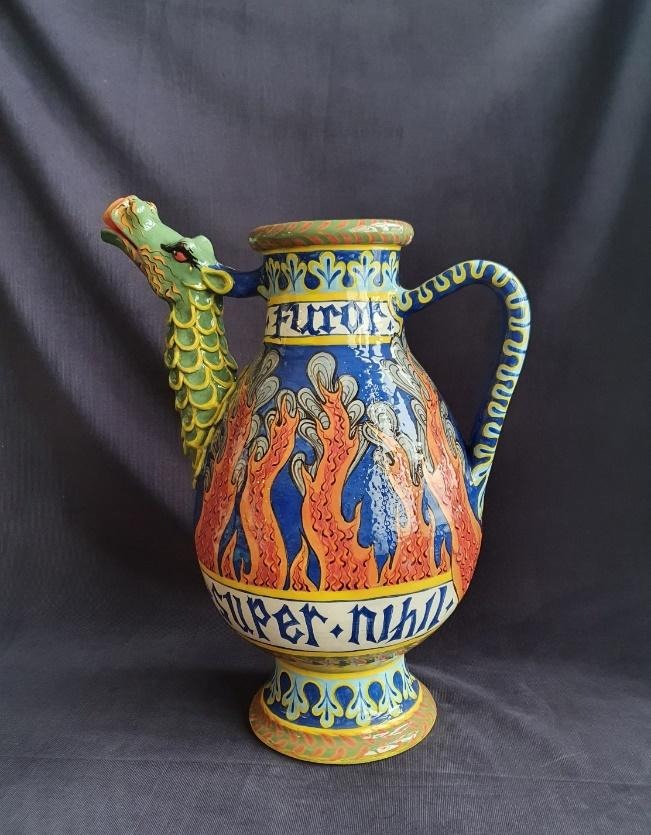

Inspired by a beautiful example of this type of jug found at the Courtauld Gallery, illustrating the occasions* when I’ve been consumed by an ungovernable, explosive rage. I was pleased at the idea of reclaiming the dragon/angry woman association for an empowering use of my own.
This type of maiolica is known as the ‘Orsini-Colonna’ style – which refers to Maiolica vessels made in the workshop of Orazio Pompei in Castelli.
*EGO IRATUS SUM SUPER NIHIL – I become enraged over nothing
A snake-handled, lidded pharmacy jar
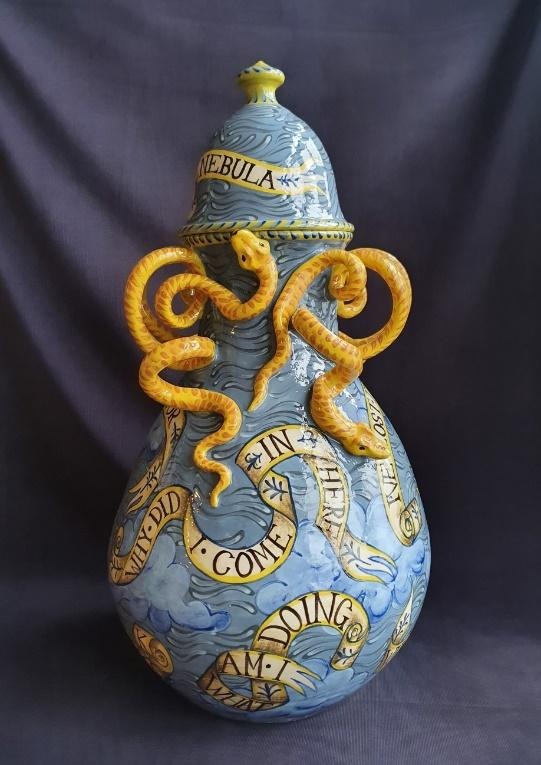
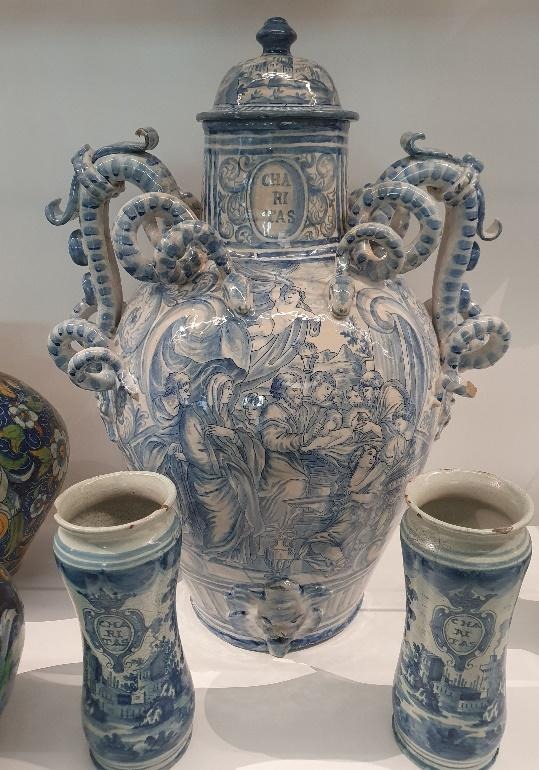
I saw a superb example of a huge lidded pharmacy jar with multiple snake handles typical of the Maiolica style at the Science Museum, part of the Wellcome collection gallery. The original example is decorated in blue and white, and illustrated with a scene of the circumcision of the infant Christ. On my vase, the snakes are wandering around in confusion above a cloudy, foggy sky over which curling ribbon motifs spell out my thoughts on a bad ‘brain fog’ day.
This type of ribbon decoration with text was used frequently in Renaissance Maiolica. I read somewhere that it was meant to imitate paper or parchment labels that were stuck on to containers to reference the contents; the labels would start peeling off and curling up over time so this was a way of permanently marking the contents. There are also a lot of beautiful examples of this device on Renaissance portrait plates, with the ribbons curling around, over and behind portraits of saints, matrimonial couples and other notable figures. The ribbons I’ve made on this jar have frayed ends to symbolise my unfinished, broken thoughts.
Lidded Albarello jar
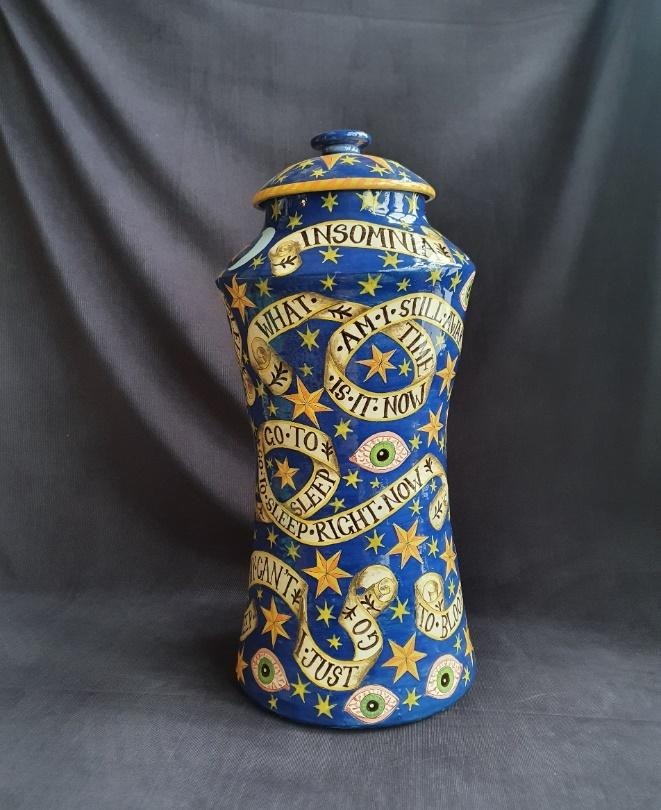
An attempt to describe the infuriating stupidity of my thoughts when I’m wide awake in the small hours.
Albarello jars were used to store powders, herbs, or ‘dry’ medicines: the wide open top and neck, and the stable base, were designed for ease of use, as the physician or apothecary could then easily put his hand inside to take a handful of the contents, and the narrower central part of the vase enabled the user to take it off a storage shelf and replace it with one hand. These design features make the Albarello shape a very recognisable one from the time.
Snake handled Vase
Depicting three types of Hormone Replacement Therapy – the pill, cream or gel and the patch, and giving thanks to the modern age of medicine that makes this therapy available. IN LAUDE HORMONE REPONERE CURATIO = In Praise of Hormone Replacement Therapy. The inscription around the neck reads VITA EST REDIIT, which translates to ‘My Life is Returned’.
In contrast to the wandering snakes of the ‘Cerebrum Nebula’ pharmacy jar, these snake handles are in happy order and symmetry.
My life would have been very different without access to HRT and I feel extremely fortunate to live in a time and place where this is available.
Albarello Jar
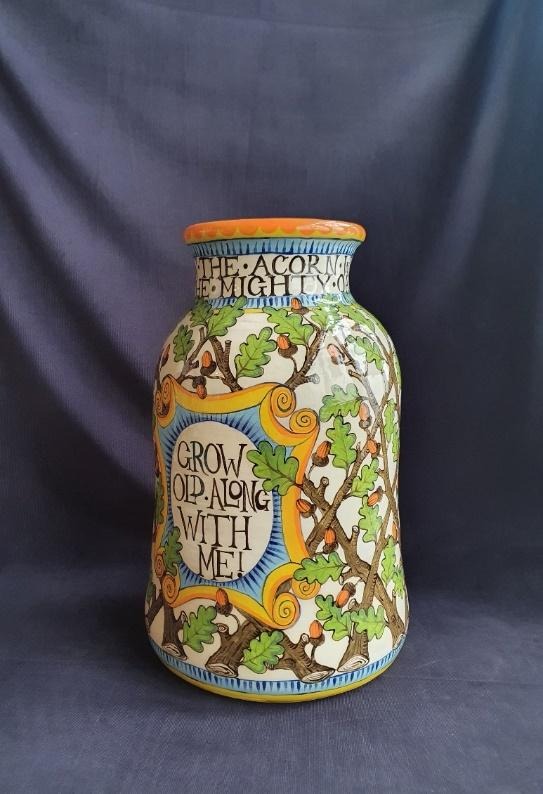
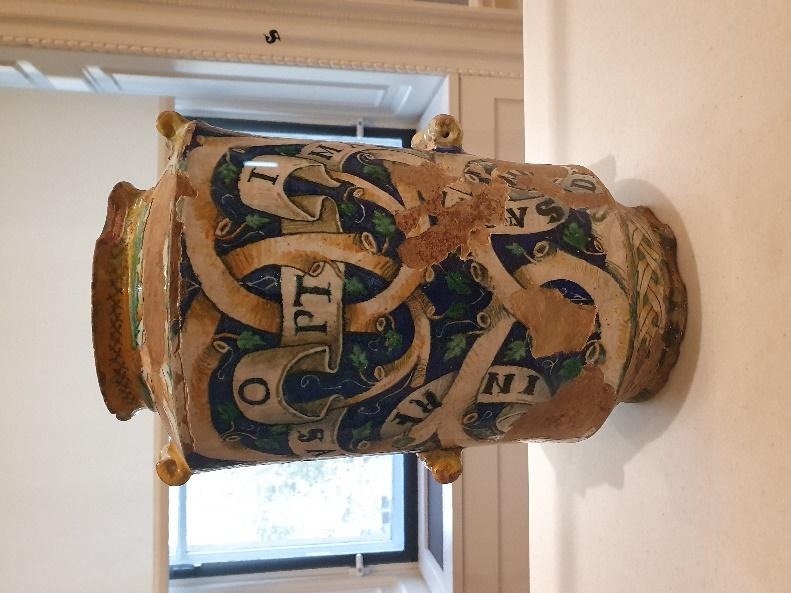
A wide, barrel shaped albarello jar, inspired by my favourite piece at the Courtauld Gallery. Focusing on the benefits and joys of maturity, it’s also a plea to recognise the value of women who are past the age where physical beauty takes centre stage. The inscription around the neck reads: ‘Do not shun the acorn when it grows into the mighty oak’.
The first two lines of Robert Browning’s poem, Rabbi Ben Ezra – ‘Grow old along with me! -The best is yet to be’, describe the benefits and delights of the second half of life. We can now fully and confidently inhabit ourselves in all the wisdom and maturity we have accumulated, stop worrying about unnecessary things and be glad to have come this far.
Wet Drug Jar
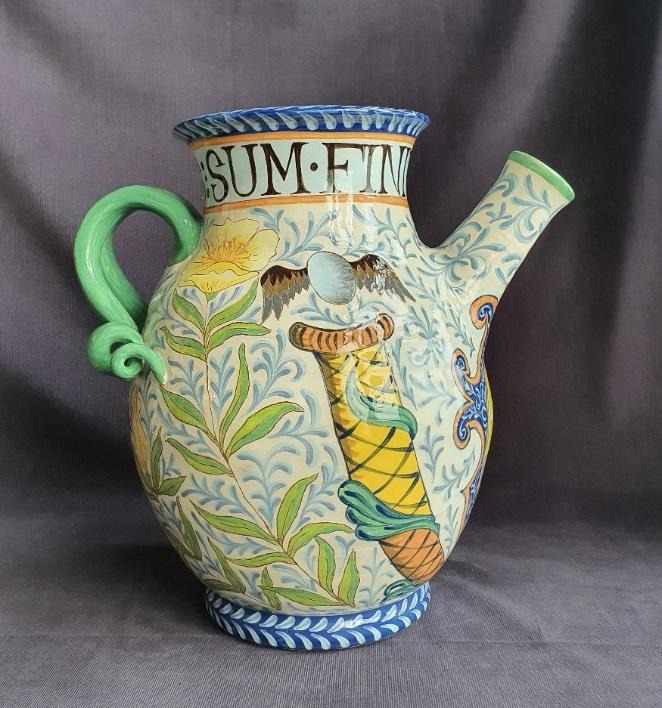
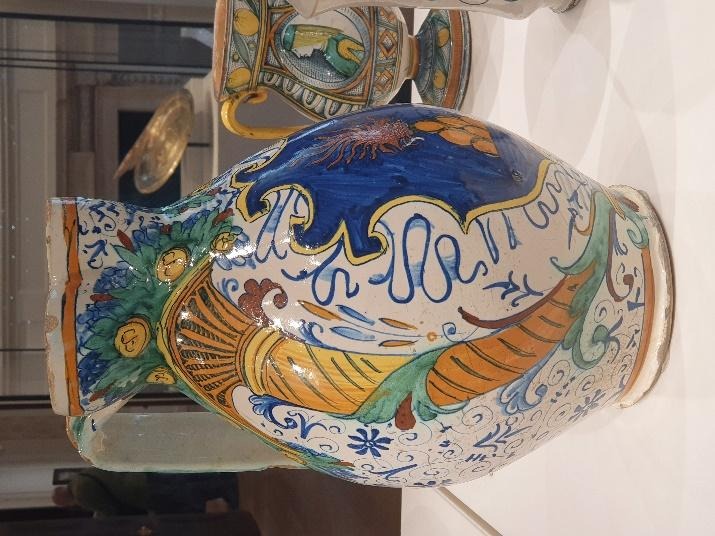
A wet drug jar bearing an imaginary coat of arms and motto for the Guild of Menopause. I’ve noticed that once we reach a ‘certain age’, women enter a kind of secret society – we recognize and acknowledge each other in public places and in passing with a subtle look, a smile of recognition and solidarity; this makes me feel as if I’ve entered a secret society hiding in plain sight. We see each other, even if nobody else takes notice.
The motto reads ‘SUM FINITA EXCUSANS’, which translates to ‘I am done apologizing’ (menopausal people will relate to this!) and the shield depicts invented symbols of menopause – fire/hot flushes, water/night sweats, the moon for its influence and an egg on wings to symbolise the cessation of fertility.
I saw some beautiful Maiolica jugs with coats of arms on them in my research, and one in particular at the Courtauld gallery caught my eye. There is often a decorative device of cornucopias framing the coat of arms on jugs of this type, whose shape reminded me of fallopian tubes – so my cornucopias have eggs flying away above them. The flowers are evening primrose, a well-known herbal remedy for ‘women’s problems’.
Whilst working on this project, I’ve become very interested in the use of symbols in Renaissance art; I read a fascinating article about this which explained that although the vast majority of people at the time were illiterate, they would be fluent in the language of symbols, so could easily read the meaning of art in churches, on shop fronts, family crests and so on, being familiar with the meanings of fruits, flowers, animals and so on used to denote characteristics such as virtues, professions, family names etc. I really enjoyed making up my own symbols for menopause, and am planning to carry on inventing my own dictionary of symbols in future work.
Katrin Moye, February 2024


