.svg)
I’ve been a huge fan of antique Delft tiles for many years. Individual tiles are often spotted at antiques fairs and in shops and are a charming little window into the lives of ordinary people from hundreds of years ago; but the impact of a whole fireplace, or even an entire room tiled with these exquisite handpainted miniature scenes has to be seen to be experienced.
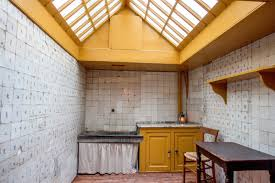
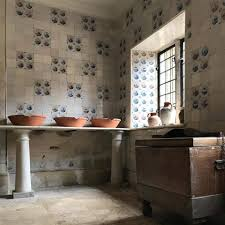
I first encountered this at the ‘Church in the Attic’ museum in Amsterdam (https://opsolder.nl/en/museum-our-lord-in-the-attic/ – the kitchen and stairwell there are entirely covered in Delft tiles, some with tiny scenes of children playing with hoops and balls and so on, and others left undecorated – seen en masse like this, the handmade and wood-fired nature of the tiles really stands out. There are such beautifully charming gradations of white in the tin-glazed surfaces; from pearly grey to cream, palest blue to cloudy white. But of course the miniature landscapes, people, flowers and patterns painted in various shades of cobalt blue have a showstopping impact when seen in rooms such as the dairy at Dyrham Park near Bath (https://www.nationaltrust.org.uk/visit/bath-bristol/dyrham-park ) , or the bathroom at Packwood House in Warwickshire (https://www.nationaltrust.org.uk/visit/warwickshire/packwood-house/visiting-packwood-house ).
My collaboration with Balineum is an attempt to create an homage to the slightly haphazard charm of a large surface covered in a variety of antique Delft tiles. I’m especially pleased with the way that the highly skilled makers and decorators at Phoenix tile factory have retained the charm of the hand-made in their interpretation of my designs – from the brushstrokes visible on the engobe backgrounds to the detail on each and every tiny leaf, stem and mystery fruit on the decorations. I can’t wait to see these tiles in use and am very tempted to tile my bathroom at home in them!